Sack the first Superintendent who practices racism or demote them for racism and overnight there will be change in race relations of the type never seen before in policing circles………………
The Macpherson report published in 1998 was said to be, by the then Home Secretary Jack Straw, a watershed in British policing and race relations. The aim of this paper is to consider how much of a watershed the report really has been in terms of the ethos of the reports and its recommendations from an organisational perspective, to provide an accurate reality of race relations facing police organisations up and down the country today. It is important to note the base of this report was written before the findings of the CRE investigation into police racism were published in 2005.
In short one feels that there is much stark evidence that the implementation of the Macpherson report has been severely watered down since 1998. This evidence comes from many sources and individual examples that have been provided across policing in this country as well as from personal experience since joining the service some 15 years ago.
This paper also suggests that those in police and other organisations who had been handed this change privilege have actually made such significant errors and oversights, but it is not as if these errors been stopped; moreover these errors are still allowed to continue and as such this is an indictment on the police organisation and it’s people as a whole.
Lord Macpherson in 1998 made it clear that Institutional racism did exist, he acknowledged it’s relevance not only to British policing but to British society. But this definition was not a new one. Macpherson also stated that police organisations should listen to their Black Police Association’s but here he may have been misinformed. Here one could state that there is Black that is White and Black that is Black and whilst this statement may appear offensive it is very much a reality in British race relations as it currently stands. This paper, therefore, hopes to restore this long overdue undebated matter and other distinctions that impact upon effective race relations.
As an academic, Covey, when referring to people inside organisations, put forward a view that actually it is imperative for changing organisations to listen to those with the inside knowledge to effect the relevant change. He also put forward the view that solutions to issues are unlikely to come from external sources. In other words he stated:
“And in all of my experience, I have never seen lasting solutions to problems, lasting happiness and success, that came from the outside in. (Oakley and Krug.)
This statement in itself is critical to the success or ultimate failure that effective ‘race’ relations is likely to have inside policing and the impact the service can have in leading society through the change. Macpherson talked about Organisations such as the service which have a hierarchical existence are always dependant upon the understanding of it’s leaders, and of course some of this is necessary for part of the policing role. However, this status is not what is required when talking of what is the required ‘race’ change in the service.
Although police organisations may appear to be changing their policies; this change historically has been deemed of little use; as change of this type cannot really come from the outside in, nor can it be a matter of policy; but it must come from the inside, through compassion and experience. The question that must be debated is from where on the inside does the change come and where has it come from in the past.
Lord Macpherson in 1998 could not have evidenced the blatant racial misuse of Black people inside police organisations by not just White people but by some other Black people from inside and outside also, (hence the reference to Black that is White and Black that is Black). But since 1998 this observation has been a matter of course, and this behaviour is racist.
However, this abuse remains a thorn in the side of anti racist practitioners to date but in essence it’s problem lies only in the controlled dominant power base within police organisations, for example Centrex, the NBPA, ACPO, the Home Office, etc, and perhaps other organisations also. All of these bodies still remain primarily White. Perhaps the operative phrase to use in this example is that these bodies have merely offered tokenistic gestures to date. The Police Federation on the other hand has been more understanding recently, but this did nothing for those that needed support before and around 1998.
One could argue that the strategic interventions of the Macpherson report have therefore been so badly flawed to date across police organisations that the operational impact of ‘race’ equality has been marginalised further by such individual senior, middle and junior attitudes to the point where ‘race’ as an issue is covertly rubbished by some. Of course, accepting freedom of speech as core to democracy, such views as depicted only typify the nature of the current problem that policing is faced with.
When people suggest things cannot change overnight actually they are wrong. One would argue that if police organisations sacked the first Superintendent who practiced racism then the trickle effect would be overnight and this paper concludes as to why this drastic action may be the only way forward as individual accountability must become the key performance indicator in this field. In essence one must consider not only what has gone wrong, but also why it has gone wrong?
The primary core concept and business philosophy that packages ‘race’ inside police and other organisations is flawed. Without doubt there exists a ‘safe’ yet misconceived belief based in the hierarchical ownership of business sectors within organisation theory amongst leaders at the heart of British policing, (e.g. ACPO, the NBPA, The Police Federation, Centrex), a view that ensures Managers and Police leaders place the concept of ‘race’ in a basket amongst all other policing functions of a police organisation is now considered outdated.
The above behaviour is not just practiced in policing circles but is one that is endorsed by learning centres in policing which espouse ‘race’ excellence through, for example, the Police Leadership Programme, (PLP) for minority ethnic individuals, and through other public sector bodies also.
The question that must not be asked is, since its inception how many minority ethnic officers or staff have progressed through the PLP programme, but have they progressed through the organisation by adopting a leadership style akin to the programme, which is actually quite ‘racist’ in it’s methodology? Or have they progressed by being part of the status quo? And what of those that remain ‘honest?’ Who actually benefits from the honesty and integrity of some Black colleagues that refuse to compromise on race issues?
Essentially these people who choose to disown their own ethnicity perhaps do so to survive and may be like their leaders and care only for personal gains as opposed to minority disaffected communities. And what development has there been for those officers that refuse to compromises on a learnt skill that suggests, ‘behave like me and you will be fine’, ‘behave like you and we don’t really understand you.’ The PLP on its own deserved further consideration in this paper. Interestingly the PLP has come out shining in the recent CRE report. I for one do not support this course. However the course was promoted by Ravi Chand as the then President of the NBPA. He is now a Commissioner in the CRE. And the course is delivered and supported by the current President.
On the other hand anti racist practitioners will suggest that ‘Race’, however, is so core to every policing function and runs through most organisations that it is totally integral to each function and such an overview, as above is actually only White ethnocentric focussed. In other words, such approaches can never succeed. For example, traffic processing as a function in ethnic areas might wish to take into account the lifestyles of minority ethnic groups in terms of policing the traffic issues in the area and if people are treated differently then treating differently respective of ‘race’ may not be unfair. But it is still seen as such. We are well aware that the Asian community does not see obstructive parking as an issue, but this is from the perspective of their experience in India and in East Africa. On the other hand it may be deemed to be fairer as a result of the ongoing hardship faced by such communities. Police Officers and managers in ethnically concentrated areas may wish to very much balance prosecution decisions with discretion in relation to parking offences, obstruction offences, and carrying children in vehicles, for example. Instead, in relation to prosecutions do we appear to practice disproportionate measures that are then deemed racist? However, it is also suggested that such discretion may be viewed by those inside as unequal policy and therefore unfair in terms of the treatment between Black and White, but if this is the case this is only so because diversity is not understood.
The idea that this papers wishes to espouse is that social cohesion in certain areas may already have landed on disaffected minority ethnic families a disadvantage and police actions can further add to that disadvantage or they can try and break this cycle.
After all it is very likely that the majority of White middle class people are likely to be ‘model’ practitioners of traffic matters because actually they do not suffer the same disadvantage of Black people, nor do they have the same experiences or background. Furthermore, and in comparison between White and Black working classes the findings if they are ever made may indicate further disproportionality against Black and Asian people. I would refer to this as the cumulative impact of racism.
Packaging and de-operationalising ‘race’ not only institutionalises ‘race’ so that it cannot be dismantled but it depersonalises the ownership of ‘race’ change to the institution, as opposed to the individual, and within ACPO, this institutionalisation is a sad state of affairs marred by further ethnocentrism. In the case of ‘pass the parcel' with the race portfolio; one wonders how effective is this policy and who is then accountable or is it acceptable that no one is held accountable? I fear that the latter is the case due to a lack of understanding.
Such irrational behaviours are still real inside the police organisation and insular amongst non-police organisations that we are having to work with, and some of these other organisations are arguably still way behind the police service, and when these other organisations do wrong, who is to take the lead? If the left hand does not know nor understand what the right hand is really doing in terms of partnerships and ‘race’ does it really matter what the left hand does to the right hand and vice versa?
There is, therefore, little monitored co-ordination amongst partners and whilst ‘race’ does not affect individual White and Black managers in positions of power personally then it’s progress appears really not to matter at all other than until the time of inspections, and then all activity seems to take place, activity which is knee jerk and for the sake of nothing.
Thus, when organisations then further choose who then is unlikely to be brutally honest in relation to speaking with the inspection team, allowing only these people in or leaving this task to nominated Black personnel, one wonders what the term collusion really means.
Furthermore, ‘race’ change in most cases inside police organisations is delegated to Diversity officers or units. But more often than not these units may not consist of people really ‘fired’ up to change the system for the good of everybody. One must also question some of the motivation of such individuals in such posts if they do not do what is right when it is blatantly obvious.
The view that they may win another day is not appropriate for those that have suffered racism at that time. If such units then compromise on the ‘race’ issue what then? Race change cannot exist inside one unit in this way, but it does.
Of course some of these people may be Black, but an organisation in denial is unlikely to place someone real there until some time has passed. But moves and posting are often carried out by a White ethnocentric powerbase. In this delegated way failure can be blamed on others as opposed to the self; and change is not deemed necessary because it cannot be seen by the person with the power to effect change. In other words the status quo is maintained for as long as possible in real terms. Power to effect the change and knowledge of the subject are not seen as correlating skills inside police organisations still. Moreover they are seen as threatening behaviours. From the highest perspective one would suggest that drawing individual liability away from the ‘self’ is based on the fear of ‘self’ competence and the unknown and each person in the ‘race’ decision making chain is likely to be less competent then their manager, bar a few radical people, but these are few and far between. And even then these people are kept at a considerable distance from the change.
As an example, post the Secret Policeman documentary in which discrimination towards people of Asian origin was exhibited; ACPO’s knee jerk response was to produce partner ‘race’ audits. The methodology quite simply was that Force A would examine Force B and vise versa. However, there was clear evidence that those Black and White people that were entrusted to carry out audits were not the most suitably qualified available or were not prepared to be ‘honest’ with their findings for fear of losing their own privileges given to them by the organisation. The impact this than has on the truth is detrimental. One could therefore conclude that some if not most of the evidence produced from these audits was collusive and corrupted specifically in relation to Asian people. Not only was the evidence portrayed in the documentary mentioned, offensive, so too was the resultant police action, which was on effect secondary or post modern racism. The consequences of such collusion can only be dire. And critically the service still refuses to deal with this very obvious shortcomings in an open forum.
From this one critical behaviour, (the conduct of the ‘race’ audits), one can suggest that the real impact of the Macpherson report upon policing and society since 1998 remains patronisingly minimal because of this and other organisational behaviours. Oakley and Krug describe this type of organisational behaviour very well.
“What happens when an organisation – however well intentioned – tries to change structures and processes first? Invariably there is a degree of resistance, usually substantial. Much energy is then wasted on overcoming this resistance to change. The resistance actually negates much of the value of the process changes that are sometimes vitally needed. Yet the classical approach to change has us first implement system, structure, or process changes to deal with a
problem, then expend tremendous energy and resources tying to overcome resistance to changes, attempting to gain buy in for them from the people.” (Oakley/Krug).
Of course the police service implemented the ‘race’ audits quickly and the task was a mammoth one, but why such audits not occur pre the Secret Policeman? Perhaps we should be grateful that the service did do something at least, but does it not matter that the audits actually meant little and that what the service did was never going to mean much?
One cannot buy in to something that one neither experiences nor believes in and policies, attitudes, and processes will not necessarily impact on the mindset or behaviour that causes systemic racism’s, the types of which were depicted in the documentary, and arguably still lurk inside management structures unchallenged.
One would argue that a knee jerk reaction was not what was required and actually evidence that the nature of the problem that still exists has still to be dealt with. Of course many Police and non-police leaders will maintain that much was and is happening, policies are being developed, training is being completed, but are the policies the best they could be? Is the training the best that it can be? If the first audits after the Macpherson Report were corrupted in this manner then what must now be severely tested is the strength and commitment of the strategic interventions now at this point in time. Some behaviours merely allow organisations to be able to tick boxes relating to strategy but dealing with people of colour in terms of compassion on non discrimination is where the point of Macpherson remains totally lost within police organisations; and in non police organisations the situation is considered much much worse.
Of course the police service can have an almost immediate impact on its honest credibility in ‘race’ amongst the affected British Minority Ethnic, (BME), communities if it was really strategically prepared to understand the change that is now required and that which it still reluctantly gives. The police service must also acknowledge the privileged position it actually is in; in leading this change. If the current leaders are not prepared to do the right thing then perhaps they should move on.
Even after the death of Lawrence in some police organisations those in positions of power do not wish to acknowledge that the subject of ‘race’ is to be considered on equal terms as a specialist area within the policing function. Strategic interventions involving secondments to such specialist areas demanding an understanding and experience of deprivation appear to be based on personal career advancements, rank, and a desire to release people, as opposed to suitability based upon knowledge, understanding and racialised experience.
For example, theoretically speaking, placing a Senior manager in charge of ‘race’ when that manager may themselves inadvertently practice ‘race’ discriminations will hardly expose the real change that may be required. It may be that the service has seconded people based upon rank to improve their own career potential but is this right way to affect ‘race’ change?
On a separate note one can still argue that the life opportunities for Black and Asian people are still so generically disproportionate in certain geographical areas throughout the country, but this is not a police issue! I would argue that it is a police issue. It is an issue when and if we start arresting people disproportionally or criminalising people in this way that it becomes a police matter.
This position is real in parts of London, parts of Birmingham, Nottingham, Manchester, Leicester, Oldham, and Burnley; and here the lack of opportunities place undue pressures on policing and provide very serious implications for crime and deviance, such that society deems it only appropriate to ‘criminalise’ Black people further.
The recent and continued position in Iraq should lead us to question how a young Muslim male may be disadvantaged now and indeed how young Asian males will be affected by the war on terrorism, but these thoughts appear to be outside our police vision? And are the root causes of disaffection being dealt with generically or is the police service left to do it’s very best. The areas mentioned have already seen violent clashes recently and to say that ghetto’s do not exist in parts of this country is denial.
As such the police service may wish to recognise the specialist nature of ‘race’ through cross national police assistance for example but instead it is as if Senior officers are leaving individual issues to respective Forces as opposed to promoting a united response. The potential consequences of not recognising and addressing this matter is that certain geographical areas in this United kingdom, (for example parts of Scotland), are likely to re-experience the type of ‘race’ riots and racial murders that parts of England experienced in the 1980’s. Is it worth taking this risk yet again?
Organisations that lie about the true state of race relations are corrupt and whilst this might be considered to be a brash statement, it is the truth. From the very top to all functions within the police organisation from people management through to assessment, recruiting, admission, probation, career development, complaints and discipline, and advancement, the service still has made little progress that amounts to dignified treatment of BME staff, especially those that challenge inequalities.
For others that are prepared to toe the line the gains are personal and defy equal opportunity. The marginalisation of people, (such as Supt Dilzaie and others), people that challenge legitimately is so systemic and ingrained at various levels within the whole organisation that their existence inside is seen as incompatible, almost too ‘radical’ and difficult. And the people that do challenge but are not understood are often termed as academic and philosophical because of their challenges to managers. Their challenges, however, are not personal but managers often receive the challenges as an attack on their own styles and as a threat to their own personal competence.
And so selling the organisation in a ‘false’ way can only be achieved by using some ‘Black’ people within functions such as recruiting in a tokenistic manner, but then how is this message received out in the community where young Black and Asian men have experienced marginalisation in society as a whole? And what type of person is the service trying to recruit in minority ethnic people when the Black people with a voice inside organisations are used to temper the ‘real’ situation?
What of the potential link between violent crimes/ethnicity and stereotypes? It is now absolutely fundamental that what will also assist the whole National organisation and operational officers is an admission that ‘race’ stereotypes do acutely apply and are derived from zero cohesion in the community.
And as a concept, ‘zero cohesion’ is not necessarily derived from policing interactions but can be further added to by police interaction. That there are very serious ethnic concerns in certain areas of deviance, for example in drugs and firearms is something that has missed managers totally or they do not wish to talk about it. This must be acknowledged from a root and preventative perspective as opposed to a reactive and judiciary perspective if disproportionality between White and Black is to be tackled seriously. Otherwise what really is the point of ‘race’ strategies? For every little bit of pride that police managers hold on to in relation to their own poor understanding of ‘race’ a Black person will be innocently hurt and/or killed in street survival constructs within various core deviance’s if things continue as they are. It is almost as if this fact does not matter.
“Many leaders tend to focus on hard issues because they bare easier to see, recognise, and measure, and in some ways they seem easier to address. Leaders also place importance on hard issues because they seemingly are based on fact, and factual matters can be debated, proven, and strategize. In addition, for must of us, it is more comfortable to address these concrete, non-human issues. Yet, addressing hard issues just because they are more tangible and measurable is being like the proverbial drunk who looks futilely for his keys half a block away from where he lost them, reasoning that “there is no street light down there.” Focussing on the hard issues because the means to address them seem clear does not make the problems – only the symptoms – go away. Real problems do not often go away when ignored.” (Oakley/Krug)
The truth, (that others may term as soft issues, i.e. ‘race’), will never go away whilst at the heart of policing lies the core concepts of honesty and integrity in some colleagues. Not many strategic, and strategic does not equal senior in rank, managers inside the organisation and outside wish to own the precarious link between ‘race’, racial stereotypes, racial discriminations, racial disaffection and the committal of drug and/or gun crime. On the contrary some Police Managers and the Home Office appear to be led by performance, detection’s and comparisons, the requirements to record crimes and detect may be irrational when contrasted with effective ‘race’ relations.
Statistics may show that moving policing away from discretion and towards stops, searches, recording, and investigation of sometimes-minor matters that affect Black people disproportionally may also cause a full circle movement against the work of Macpherson.
We have all heard how Black people that are not drunk in comparison with their White counterparts may be prone to arrest for public order offences simply because of where they reside or where they frequent; yet the same behaviour in a White middle class town may receive a caution. But why are we just predominantly policing minority ethnic people in this way? Whose problems are these? Sometimes one wonders what all the fuss is about as anti racist practices are then neutralised with counter active practices, which criminalise Black people further.
Some Police managers may wish to ponder on the words of the late Freddie Mercury and deduce for themselves what Mercury’s words might mean in the case of a youth who has just killed another youth in a gun related incident.
“Mama I just killed a man, put a gun against his head, pulled the trigger now his dead, mama life had just begun, but now I’ve gone and thrown it all away. Mama………Didn’t mean to make you cry............I sometimes wish I’d never been born at all, ……carry on carry.”
Black and particularly Asian people still remain unloved in society. Do police leaders understand really what it must be like to grow up in a ‘ghetto’ area? What it must be like to be able to survive in a ‘ghetto’ area and what must often be done in order to survive? What must it be like for mothers and fathers who may work in lowly paid sectors, having to leave their children at home? What about education and opportunity in such areas? Or are these issues not about policing? Mercury said categorically in this song that if the person did not get out of prison then life should carry on. What is meant by this? Who must carry on? One wonders how familiar these words are as experiences to the parents of Black children who continue to be systematically institutionalised by this new type of slavery in Britain today. Or do we simply continue to say well actually it is a problem of the Black community and because it was a gay man that sang this song the words do not matter either?
The truth is the life of Black people is still considered worth less than the life of a White person but this fact appears not to matter to those in power. Leaders may wish to listen to these words very carefully because there is sometime no life for some disaffected people of colour.
Therefore, it is suggested that any managerial stance that ignores this fact does not take into account what it is like to be Black and disaffected and only serves to allow ethnocentrism to play off Black against Black and avoid the real issues affecting Black disaffected people. One would argue that this is colonial rule all over again! In essence police organisations that do not see beyond performance merely end up institutionalising ethnic groups both inside and outside further and again in the late Freddie Mercury’s words,
“another one bites the dust”,
Black and Asian life still cannot mean that much to some people. It is almost as if some managers irrespective of their own ethnicity wish to leave some Black people,
“sleeping in the ghetto,” (Akon), of the organisation and society and this is a sad indictment in what is termed a civilised British society.
It is probable that British society has severe ‘ehnicisation’ problems still of Black and particularly Asian peoples. And across parts of our major cities in England, Wales and Scotland, after the 1980 race riots one can still picture ‘ghettoised’ areas in parts of Leicester, Birmingham, Coventry, Manchester, Lancashaire, Luton, Glasgow, and areas in London such as Harlesden, Willesden, Clapham, Tooting, Brixton, Tottenham, and Tower Hamlets, these are just a few names areas. In these areas many a Black child and parent have fallen victims to society’s ills and whilst the police service may not have caused these ills, it has had to police these people and as such has perhaps, sometimes unwittingly played a contributory role is disaffecting people of colour in relation to stops, stop searches, prosecutions for petty crime as well as more serious gun and violent crimes. In other words community and race relations is not without complex problems. If ‘race’ equality has changed little over time since the 1980’s really how civilised have government’s, councils and past police leaders actually been? As long as it is not a white ghetto, it doesn’t really seem to matter?
Surely a ‘race’ friendly approach would ensure policing took on a more preventative long term role to identify those most at risk of particular deviance’s and to distract them within a partnership approach. Some would argue for those individuals that are diverted from crimes, that someone else will take their place, but if the police service and others do not try then they will never know and it is this type of defeatist attitude that has prevented the real success of ‘race’ relations to date.
Placing and showing a Black face on a recruiting campaign poster is not the answer to effective race relations, but it is the preferred first resistant response. And distractions of a preventative nature may succeed if such practices were operated on a national basis and across Force boundaries and progress could be monitored and measured also.
If the service joined wholeheartedly strategically with education, and sport, including premiership football, county cricket, tennis, rugby, athletics it would not take much to convince that people diverted from serious crime to these areas are likely not only to succeed well, but they are likely to gain access to certain areas that have actually been out of bounds for Black and Asian people, and are still out of bounds today. This would be effective race relations.
Yet the police service in consultation argues that it does consult with the BME community. Sadly this is absolute cods wallop! Selective consultation with the BME community and its abuse of BME people really must also now be stopped. It is imperative that police managers end practices amounting to selective consultation with representatives that purport to represent multiculturalism, but are actually from a class that is financially able to buy themselves out of ‘race’ disaffection or from a class that supports racism. What really is the point of consulting with those that may be wealthy enough to buy themselves out of race problems?
One would suggest that attention must be directed towards those that are actually disaffected people of colour and those that work with them. For example, it is imperative that the service consults with young African Caribbean and Asian men within certain age groups as well as with new communities.
Although this may appear to be difficult to achieve the flaw remains that those that are tasked with consultation seek only to do the bare minimum because they do not have the knowledge or experience to understand core ‘race’ issues. Consulting with those that neither have the recognised understanding, qualification, experience or attachment to those that the service are likely to deal with makes the consultants appear professional, when in fact they are not.
This failure is an organisational failure and departments and individual managers that promote such activities need to be aware that actually their behaviour amounts to deception and corruptive racism’s to protect only themselves and their own incompetence. Their behaviour actually does nothing to prevent assault and murder based on ‘race.’ The upward management loop of a lack of understanding allows these behaviours to foster deep within organisations in an institutional manner.
What of research? There are serious flaws in the research of Holdaway and Cashmore. Some of this research may provide some insight but it does not provide an accurate picture of reality. Research must now be conducted from an alternative Racialised Insider Perspective, (as defined by Barot as early as 1998).
Definitive research must be conducted to explore crime, stops, stop and search, deviance, arrest, charge, disposal, and mental health across the whole spectrum of the judicial system and society and that this must be both geographical and demographic. Only the police service can lead this initiative at this point in time. The research must differentiate between Black, White, religion and faith as well as ‘new communities’ entering this country and more specifically, crime. The police organisation has been repeatedly informed of this requirement, yet it continues to disassociate itself from what really is an inevitable position by aligning itself wholeheartedly to colonial research.
What of the failing Race Relations Act? Current leadership in most organisations, including police organisations, recognise the fact that actually the Race Relations Act of 1976 is unworkable but because this flaw has worked in the favour of both past and current leadership, it remains unchallenged. Both Direct and Indirect Discrimination are so fluently acutely practised across organisations that they are acutely undetectable. This works to the benefit of managers. Organisations practising racism’s have been allowed to get away with racism’s for far too long and the Race Relations Act must take some of the blame.
With a major impact of race relations legislation affecting the police through stops and search one begs the question why the police service will not take the required lead in asking for further sweeping changes to be made to this rather outdated legislation. These changes may wish to take into account the nature of perception, feeling and action within the definition of a racist incident. A serious fact also remains that ‘racism’s’ and their impact on victims in the organisation or as victims of ‘race’ hate is not at all understood within most organisations.
However, the impact of racism’s particularly unique because it is based upon feelings that occur based on the actions, attitudes, behaviours, assumptions, systems and practices of some peoples, not all peoples, in any organisation and in society. Of course there is a cumulative impact which should not be forgotten here also. Hence ‘racism’ is a real key state of mind in the victim caused by actions of others. Until there is an unequivocal acceptance of the existence of racial abuse inside organisations victims remain unheard and their experiences remain unreal. In the case of institutional racism the key is management, but one would suggest that their understanding is poor due to their own lack of take up of relevant education.
Drawing an analogy between the offence or rape and race hate one could suggest that a rape may leave both mental and physical scars, but who ultimately knows the actual damage that a rape has caused, the victim, no one else. Yet, in comparison, the fact remains that it is only the English language, together with legal and institutional and HR constructs that continue to refute the existence that racism is a feeling and the experience is real. In this way when facts are refuted as perceptions still in what is deemed to be a civilised society.
One wonders how non-victims of ‘race’ are prepared and trained to recognise the physical and emotional scars that ‘race’ leaves behind. Sadly as a victim I continue to observe the impact of what race hate leaves behind in others not just through personal observations but predominantly through the number of failed internal tribunal actions post the Macpherson Report. This behaviour of challenging those that challenge is akin to the behaviours associated with the rivers of blood speech.
Nothing really much has changed in attitudes and behaviours towards Black and Asian men and women and Asian people in particular still face disproportional treatment because their language, their culture, and their faith are considered to be so different in different areas around the country. It has taken many years for some people to realise that race leaves behind a sad state of affairs for the victim which is neither recognised nor understood fully.
To the untrained eye these scars remain invisible or may become negative stereotypes and are sometimes difficult to describe. And so one wonders whether the police service can lead others and better prepare the taking and presentation of evidence for vulnerable victims of ‘race’ hate. Further, senior organisational behaviours such as hoodwinking portfolio responsibility, as already mentioned, yearly or two yearly and playing pass the parcel with this role within ACPO at the most senior levels ensures that racist systems are prolonged for as long as possible. In other words this is blatant racism.
And what about the view that some BPA’s and the NBPA movement must now not be abused by a White ethnocentric power base? In relation to Black support groups, (internal and external) there must be a firm understanding inside the police organisation that support groups and legislative bodies, whilst they appear to be working in the pockets of White institutions, are not necessarily the leading authority in terms of advice in the field of ‘race’. Change is only as good or as real as the people implementing that change. And so the fate of Black disaffected people is in the hand of a few people and unless Black people are considered a safe pair of hands they are not released to pursue equality, in fact they are severely sidelined. The National Black Police Association, (NBPA), has been abused in this way but it has also allowed this abuse. Black people who wish to stand for the NBPA must first be released by their organisations.
And some local BPA’s are so closely associated with their police organisation that the work intended for them to complete in the Macpherson Report remains unachieved because core Black people are not released or when they are released they are set up to fail, by working alone. The structures of support groups and their relationships with their host organisations continues to remain deliberately fudged by memorandums of understandings such that that the real impact of these groups is minimal. Sometimes the impact of some local BPA’s and their relationship with their ‘host’ Force is so inept that only certain Black officers are allowed into the ‘race’ remit, i.e. those that have or choose to behave ‘white.’
And it is not wrong to state that some incompetent Black people are put into positions of power in relation to ‘race’ to nullify the work of other Black officers, and for what, all for personal gain, but this is the reality of ‘race’ inside police and non police organisations.
It is a must therefore that a financially and politically independent and focussed NBPA would be a more productive and effective support group for change post Macpherson. The NBPA situation is a very well staged episode in the history of British Race Relations. Barot, (1998), suggests that a tiger without teeth will not be able to survive in its environment unless it is fed and becomes a pet. This is true of the BPA movement also. I bare no malice here when I state that the police institution still largely promotes a dinosaur mentality in relation to ‘race’ and thus remains of big stature when faced with changes that are only begrudgingly then being made over the longest possible time period. Any support group that has no power, or that has power controlled by the organisation can never effect the change that the Macpherson report promised. In other words support groups of this type remain racist also. Letting go of ‘power’ is not therefore just a ‘White’ issue it is both a ‘White’ and ‘Black’ issue.
In conclusion then, this is the aftermath of the Macpherson Report and the aftermath is not so pure because some leaders in policing and leaders in partner agencies ‘hold’ on so vicariously to the power that allows ‘race’ to foster everywhere and until this changes there can be no pride in policing and ‘race’ equality
What of Community Forums post Macpherson that are designed to take on ‘race’ issues? Are these for real or what? The main purpose of such forums which consist of the police, local councils, education, social services, faith organisations and voluntary bodies post Mapcherson was to tackle racism’s. One such forum that I have personal experience of was set up in 1998 post the Lawrence report to tackle racism’s but everytime the issue of ‘race‘ was moved forward; the outcomes would be diluted. The formation of such liberal forums was as a result of fear, the death of Stephen Lawrence and the resultant Crime and Disorder Bill. The abuse of the term ‘race’ has been systemic in such forums. Not only, after training, do some of the founder organisations not understand institutional racism’s, but many may be ruled by a belief that just because they exist as a body, they themselves do not practice racism’s. This is not the case at all. On the contrary such forums may behave badly in their ignorant stance. I have often heard the police service suggest that forums of this nature should be community led, but even if they have a poorer understanding then the police?
For example, in year 2, the forum had no idea of what to do and training did not arrive until years three and four. Instead of co-opting disaffected members of the minority ethnic community the forum chose to align itself with wealthy middle class individuals within these communities who had probably no idea of institutional racism’s also.
Despite feedback, the forum leadership continues to bury its head in the sand as did the police leadership and now in year 5 nothing other than the view that BME people are about ‘sari’s, samosas, and steel bands’, Barot, (1998), is purported as a view of multiculturalism.
To the Forum the watching, the smiling Negro and the dancing Indian nodding his head is what race relations seems to be about, not about dignity in the manner in which people are treated, but about visual acceptance and White people having a good time!
Yet every year at wintertime time I see hoards of Indian disaffected people who have come in to the area on work permits to stabilise some of the local IT industry walking from one side of the area to another for their shopping. They are walking miles and miles as our forefathers used to 30 plus years ago. These people; husbands, wives and small children walk through the cold to save some money to send home and the forum is about yearly get together, but for whose enjoyment? If forums of this nature were to consider these peoples then perhaps they could do a little bit of what is important. Do such forums really really care about people of colour or do they only care about themselves in that they are doing what they feel to be right, not knowing or accepting that it is wrong. Having been involved in one such forum for six years; enough is enough; despite their existence, these forums are not led by people that have racialised experience, and after six years they are still not ready to accept minority ethnic leadership. Not only are they are a real waste of resources, but they are collusive and as an action post Macpherson, such forums are an indictment to the life of Stephen Lawrence. Forums of this nature also systematically refuse to tackle the real issues that affect minority ethnic people in terms of education, employment, and other societal barriers but seem more impressed with spending monies towards multicultural events which serve the majority and make them feel better whilst achieving little race equality.
The following is a sad point but one that must now be made. The police training institution and courses for minority ethnic colleagues are in a dire state of affairs. It is an absolute disgrace that the current Police Leadership Programme, (PLP), is being flouted by individuals within BPA’s and the NBPA movement as a course that will lead to change post Macpherson. Here in lies a sad indictment upon those Black colleagues and managers that promote such a course, a course that is making money out of the lives of Stephen Lawrence, Michael Menson, and Ricky Reel.
An underlying assumption in the methodology of this course is that there is something not quite right with the way Black people communicate and that if they communicated differently that maybe the organisation would listen to what they have to say. This is an absolutely absurd assumption, which provides a racist methodology ingrained within the course template. The problem of Institutional racism lies within the institution, not within the majority of Black people, but within some White and Black people. Secondly, the problem lies in the attitudes, behaviours and practices of individuals within that institution.
Changing anti racist views in Black people so they become White is not the answer, for this is a racist ideology, nor is this the education that Black officers deserve or need and these practices are unlikely to remove the shackles from their hands and feet, shackles which have been there for many many years. Thirdly, only a racist belief would have us believe that as if by magic, that attendance on this course will change matters, all it will do is maintain the status quo.
This is proved by the point that those that do challenge are then severely marginalised to the point where they may lose their careers. And still the training and leadership faculty of the police organisation plugs the wrong hole. If on the other hand, it were prepared to plug the hole that exists in the understanding and ability of its leaders then that would be, not only an acceptance of the term, institutional racism, but a step towards real change.
One wonders whether the authors and deliverers of the PLP Programme would deliberate over whether Stephen Lawrence, Michael Menson or Ricky Reel needed leadership skills to survive in the institution of society that was racist at the point of time of their murders as a direct result of the colour of their skin? And whilst the Macpherson report was a watershed in the history of race relations in this country what some managers and leaders have chosen to do with this very critical report is nothing more than clinical institutional racism in adopting a blundering and ill thought through strategy that makes some of these managers as guilty of racism as the murderers of Stephen Lawrence.
Fair play for Black and Asian people that challenge the status quo for equality still does not exist in society let alone in the police organisation. However, it would be equally unfair to suggest that there does not exist in police and other organisations some people that care, understand and apply to race relations behaviours akin to integrity and compassion, but the fact is that these people have not been allowed in. These people do exist. (for example, Dilzaie, Perera, and Barot). It is only the collusive nature of the service that stifles real progress by marginalising such individuals.
Therefore, critically one of the only real achievements to date of the Macpherson report is a celebration of the life of a young Black youth by the name of Stephen Lawrence. Stephen’s legacy lives on in freedom from racism and what this boy has given disaffected people of colour is a platform on which they can stand firmly and a voice from which they can shout and fight for their right to equality. Will Black and Asian people fight back? In short yes, of this there can be no doubt. The question that remains is where will it start this time? What is likely to occur and re-occur is that Black people will continue to fight until real equality is achieved. The police service has blanketly refused to change and it has falsified its account in this area. The HMIC also have much to answer for here.
Of course the mental strain taken on by some Black and Asian people may result in their institutionalisation mentally and within the prison service also. There may be a disproportionate amount of young Muslim men from the North imprisoned and diverted to fundamental activity, (terrorism), because of poor ‘race’ relations and continued marginalisation. But clearly this is not a police problem! This rhetoric that we call race relations in policing has still a long long way to go.
The question for the National Police organisation is simple. It’s leaders continue to play ad-hoc lip service to this issue, and continues to apply interventions that fool all and sundry and achieve little. But if they do this then they need to be very aware that a tick in a box is only likely to arouse more discontent that may cause further the deaths of innocent Black people and colleagues. Those in positions of power have always had a choice but what remains unanswered is do they continue as ‘racists’, all be it inadvertently, or do they now move towards becoming ‘anti racist.’ Enough is enough.
What is a known factor though is that structurally the police and other organisations must place people with the knowledge, understanding and racialised experience in positions of power to enact a new model of true success that begins to impact on disaffected people for the first time in British history so that Black people do not continue being dealt with as the problem of the problem. Sadly British society is still uncivilised and deemed to be only touching surface level racism’s but it is still better than other parts of Europe. And the Police service is the critical partner amongst the public sector organisations.
If, however, the example of policing were something to go by then one would suggest that progress within Education, and the Health and Social Services remains equally bleak and superficial. The first response of services to claims of racism is to deny problems, then these services may fight problems, and still there is little change. Finally and reluctantly they may partially accept issues but still there will be little change and perhaps the service still has only a partial acceptance of the matters of debate. Unfortunately this is not good enough.
At present and at best, issues have gone underground, raised hopes and provided little more than a tick in the box for thematic inspections. Just as there is a distinction between right and wrong, good and evil, Black and White, there is the same distinction between truths and untruths. In race relations organisationally; these behaviours described in this paper are the truth and nothing much can improve until the truths are first acknowledged. In faith and trust terms the police service appears not to be doing what it should be doing; and a lack of integrity and honesty affects both White and some Black leaders. And why do some colleagues without privilege continue to maintain some dignity in this field? The Gita sums up this duty well.
“Do your duty without wavering; there is no greater honour than fighting in a righteous cause. To turn your back on a righteous cause, would be to turn your back on duty and honour; it would be to fall into sin. Your friends would say that you had fled from the fight out of fear; they would forget your great deeds of the past, and treat you with scorn.
Your enemies would speak about you with contempt and derision; they would laugh at your reputation for courage…Prepare to fight with peace in your heart.” (5/13: 366 readings from Hinduism: James).
I personally now am not at all convinced that the truth as depicted above is recognised fully in policing circles. But when Doreen Lawrence spoke to announce the Macpherson Report in 1998 the whole house, one would argue, was silenced. This silence, this anxious state of nervousness, inside a white institution; was though really only temporary and sublime. What Doreen Lawrence achieved on that historic day was justice for her son and this was more than what others entrusted with change post this report have achieved thereafter. This silence brought not just the house down, but it brought the whole country to a silent standstill, and some Chief Officers to their knees to account for the guilty behaviours that left not only the killers of Stephen still free but left an allegedly British democratic and civilised society guilty of the worst forms of collusive racism. In short if certain actions are not taken immediately it will be pockets of the country that are brought down in rage and with it we may see the loss of yet more life, both Black and Police.
But of all the difficulties the service faces; the most controversial difficulty faced by policing inside is it’s abuse of the NBPA and BPA movement. When this issue is addressed more vigorously and conclusively this will be a defining moment in the history of ‘race’ relations for this country. With ‘race’ there can be no compromise and the support movement must look carefully within as the movement can be, as the police organisation can, either only racist or anti racist. There no longer is any middle ground.
This paper concludes therefore that these deceptions in reporting the work post Macpherson inside the police service, which have included Black officers and the BPA’S are not the truth as it is, for without this truth, there can be no freedom for Black people, and no integrity for British policing, Black police officers and police leaders. What is evident now is this new type of slavery. In essence Black and Asian disaffected people remain still severely racialised both inside and outside of the police service post Macpherson. Let us not forget that those that continue to oppress Black people are some White and some Black people in power and that have recently held power post Macpherson and have indeed used that power in a in a manner to pursue their own career ambitions.
What is required now is a total and systemic overhaul, inclusive of promotions, by people that understand what they are doing in this field. Words such as ‘massaging’ the ego of White and Black leaders, manipulation, being economic with the truth, protecting one’s privilege, are all words associated with corruption and non truths and therefore words such as these must not be associated with the future success of race relations in policing and this country.
On a very personal note, some Black officers have often found that first they are ridiculed and laughed at when they experience racism. Then no one seems to understand what the fuss is about in relation to racism. They should be able to take it is what is often said and heard or muttered. This then can continue until there is a challenge and when a challenge is made, those involved become automatically collusive and the evidence cannot be located, but Black people are a part of this also. This then continues and continues and still the organisations tells Black officers that racism is a problem but it can never find the root of the problem; yet it continues to recruit minority ethnic staff into this pool called ‘fair play.’ Oh yes, it exists, they say, when talking about racism, but not in here and we don't have to admit it do we? Hence to some colleagues the reality of racism as an experience is nullified by management’s dispersal of the concept of race as 'false', as a mere perception and a reluctance to admit problems lies at the heart of the legal or civil remedy issue. This whole existence then becomes the experience that was never real for Black officers that have challenged legitimately between 1998 and 2004, perhaps even well before 1998. And so some colleagues are left institutionalised severely for the sake of the reputation of the organisation or the Chief officer Group. So, what then is the real consideration of consequence here?
Is the reputation of the relevant organisation so much that it must be protected by racial lies? Or is it purported competence of its senior management team more important or is it truly the reality of racism as it affects individual people of colour? For long enough individual minority ethnic staff have internalised these issues because they have been unable to do anything about them but the truth is, this sad state of affairs post Macpherson is the problem of the most senior managers in the organisation, who, if they continue to fail, are leaving themselves very wide open to very serious issues of neglect.
Returning to where this paper started,
“Sack the first Superintendent who practices racism or demote them for racism and overnight there will be change of the type never seen before in policing circles. These officers are the junior of the senior management. Not only would a demotion send a very startling and spine chilling message that is now required to the people ranked below the Superintendent that they cannot continue to collude in the old ways, but it will send reverberations upwards to the highest ranking officers that they also can no longer collude. (Joshi, 2005.)
Of course, police organisations can keep promoting these same people that collude and do not rock the boat, but those that do promote in this manner, need to understand that they are then as guilty as the murderers of Stephen Lawrence.
Importantly these managers need to understand that whilst there is a way up in the promotion stakes there is a way down also as a result of misuse of ‘race.’ To date this message has neither been appropriately sent or received by police personnel.
What is now urgently required is a strategic group consisting of racialised individuals that have no white privilege; names such as Dilzaie, Barot, and Perera should be names that are allowed in; not deliberately left out. What is not required is an advisory group that does nothing for Black and Asian people that are marginalised, but a strategic group that can really guide ACPO and impact upon change. Enough is enough. In 2004 to say that the Macpherson report is actually taken seriously by some police managers is an indictment on the life of Stephen Lawrence.”
The death of Stephen Lawrence clearly was not enough, the deaths of Michael Menson, Ricky Reel, and countless other Black and minority ethnic people is clearly still not enough. The Secret Policeman brought a collusive response that even ACPO could not control, because ACPO delegated the task to incompetence. All this has resulted in appeasing policies, not equal opportunity or the dismantling of hurdles that we have to continuously jump through.
We are intelligent individuals not uneducated servants, and we remain ignored by our own and by some of the organisation. History will account for the fact that not only has the racist part of the organisation abused us all, but so have some we consider represent the interests of BME disaffected people. Perhaps the operative phrase is that these peoples just represent themselves, and that is all. The Police organisation in listening to these peoples have perhaps put the whole country and colleagues at risk and back in terms of race relations.
This paper is served as yet another reminder today about the maltreatment of Asian people inside the organisation. Asian men and women in the police service, unless they behave in a ‘White’ fashion, are severely racialised and one can go back as far as 1990 from where one can produce this evidence.
Only when people are prepared to lose the privileges that may have got them where they are in so called privileged positions, will they perhaps have some understanding of what it is like to be in a minority. Until then these people are a part of the bigger problem.
For me, I can for once, proudly call myself a ‘PAKI’, in owning historically my own treatment inside the service I have nothing at all to hide. At each denial point in time since 1992 some of us have still stood firm and maintained our honest dignity, which is more than can be said for some of those that have progressed through the organisation.
I accept that this is what I am viewed like by some colleagues, some of whom are more senior than I; senior they may be, but they are not at all superior in terms of ‘racial supremacy.’ These issues contained herein this report are not my issues, they are yours, and despite being advised that some of us are being heard I believe this is not at all the case. Every gasp of our breath and trust towards management has been systematically betrayed in the past with so called ‘white lies.’
One now wonders, what is new, let us not forget that some Black people have been guilty also, but then what is the ethnicity of the dominant group that begrudgingly ‘hangs on’ to this unequal and unfair power, for it those individuals past and present that have and still continue to abuse the disaffected Minority ethnic community. Still, this report makes some recommendations. ‘Race’ will not go away, the issue will be fought and won. If the police service now really wishes to show us all that it cares then in my view, the following recommendations must be actionned without being “watered down or “diluted.” Let us not forget the events that have brought us here today, the race riots of the 1980’s, the murder of Keith Blakelock, the resultant “whitewash” of Conservatism, the racial murder of Stephen Lawrence, the bungled investigation, the racist collusion thereafter, the subsequent Macpherson Report and, the bungled implementation of this report across society, The Secret Policeman documentary and the CRE investigation into police racism; which incidentally has not gone far deep enough. Historically, the lack of progress is corrupt and it is this incompetent corruption that needs to be broken away not “chipped” at, but “broken” away from the roots. Only a Black leader with conviction and a team can now begin to dismantle this evil, malice and ignorance that exists as police racism.
Recommendations post the CRE report into racism and the police service (2004)
(1) ACPO must first ensure that ‘Race’ is understood and acknowledged as a specialist area within policing. Forces will ensure that relevant departments focussing on ‘race’ issues contain an alternative racialised perspective within, irrespective of rank. This means that Police organisations have no choice but to now those Black colleagues that do not sell out to these issues into key strategic/operational positions within the Force.
(2) ACPO must acknowledge and ensure that selective consultation with member of the BME community, or selected members of BPA’s that are themselves racist or whom purport to represent the community without academic knowledge or experience, will cease.
(3) (i) ACPO must ensure that Forces identify ‘race’ experts within their respective Forces. In essence and as a guide there may be one or two individuals within each Force who exist irrespective of rank with these skills These individuals will have a (a) thorough understanding, (b) proven experience in tackling ‘race’ issues at a local and national level, (c) as well as an academic background in this field. ii) ACPO will ensure that these individuals are not further marginalised and will pursue to sign up these people to form an advisory committee on ‘race’ issues within the police organisation and
essentially this group will act as a steering group for ACPO on the issues of ‘race.’(iii) These individuals will on a basis of Team basis be able to provide mutual aid support in relation to issues of ‘race’ tension that occur across England, Wales and Scotland. (iv) Secondments to foreign Forces will be made possible where intervention is deemed to be of assistance to the recipient Force and these people will from part of this team.
(4) ACPO will agree to critically review the support given to local BPA’s and the NBPA in terms of funding and a base level will be agreed. Financial disparity between Forces will be removed. ACPO will agree to critique the factors that allow the best people to serve on the NBPA and in other Home Office departments in relation to ‘race.’
In particular, the removal of barriers relating to rank will be pursued rigorously and secondments to relevant departments will be based on the criteria identified in 3 (a) to (c) above.
(5) ACPO will ensure that Forces will agree a minimum base standard of training delivery in relation to race’ and this must be a continuous and regular process. Suitably experienced speakers and minority ethnic trainers will from the visible minority ethnic communities will form a part of this training. Training Managers that do not deliver effective training will be removed.
(6) ACPO will pursue vigorous policies and practices that mean those that practice institutional racism will be demoted and/or dismissed.
(7) ACPO will pursue an agreement that it will pursue honest representation of ‘race’ issues from a media perspective both within and in the community.
(8) ACPO will agree and ensure an immediate and independent review of leadership training for minority ethnic staff, which is considered to be delivered from a White ethnocentric stance.
(8) ACPO will agree to review promotion and career routes for BME staff and proactively remove inappropriate promotion cliques, e.g. Inspector’s mess. ACPO will agree to review how it has pursued a “behave like me and I will promote you approach.”
(9) ACPO will ensure that Forces will review their partnerships and promote partnership work from the perspective of anti racism. Any leader not actively pursuing this process will be removed and offered alternative posting.
(10) ACPO will agree to provide a research review of national ‘race’ tribunals by Forces since 1995,within 1 year, and provide examples of racist behaviours to Forces with a view to model some learning and actions that will assist Forces in preventing racism’s. The criteria for the research will be agreed with relevant BME staff.
(11) ACPO will promote research being conducted from a racialised perspective. This research will review the BPA movement the NBPA movements and insider experience producing its final findings within 2 years to ACPO.
(12) The ‘race’ portfolio will not be passed around within ACPO for a period of less than three years. There will be set objectives for each Force within the portfolio, and every two years a report will be published by ACPO showing development. Non significant progress will be vigorously monitored with sanctions being placed on Forces and Chief Constables who do not meet relevant areas of development.
(13) Both ACPO and the Police Federation will forthwith employ selected and suitably qualified police officers as “race” advisors. These officers will pursue the action plan above and report yearly on progress.
Friday, October 20, 2006

White managers say there has been progress - b-------
When Some White managers and some Black leaders in power within the police service say that progress has been made post Macpherson, one must understand that actually little progress has been made to get rid of the racist bigotry that really exists inside the police organisation.
As a serving officer who has delivered effective training in this field inside the police organisation there are three classes of people that one comes across. (1) Some people are just ignorant because of their own upbringing, and we must be able to educate and love these people. (2)
These people are the malicious and (dangerous racists, who know full well that what they are doing is wrong, but they are able to, through intelligent manoeuvre’s, get away with racist practices. Some of these practices are verbal, some attitudinal, and some relate to the manner in which they interact with minority ethnic people and staff.
To say that these peoples are just operational officers is absurd and a get out clause for senior managers; they exist everywhere, but this an arguement senior officers have used well to blame everyone but themselves. (3) The third type of person is arguably the worst form of racist. These people are academic, they know employment law well, and these people collude systematically and intentionally with those mentioned in (2) above.
Unfortunately some of these people are leaders and managers now, i.e. they have been promoted; so to say things have changed for the best is quite a ludicrous proposition by current leaders. In promoting a type, in promoting what could be deemed as "their own", Police leaders of the past and some today are still actually creating a very dangerous environment in which racists are allowed to remain free.
Whilst these people remain free then the possibility of another Blakelock or Lawrence type murder occurring is not out of the question.
Instead of the situation getting better; it is arguably getting worse as we promote upwards, because the police service in 2005 plays total lip service to the isue of "race" and is still in some denial.
Wednesday, October 18, 2006
The Commissioner's "Bag Carriers" respond

I WROTE
I do not comprehend what you mean by, " I do not think I have had the pleasure of replying to any emails from you before." Why is it deemed a pleasure? Prior to this email I sent a message regarding the impact of stereotypes, which is clearly the email I was referring to. From your response it would appear that you do not wish to understand the impact of "race" or feel it unimportant in these matters. I am not suggesting that the Metropolitan Police do anything that will prejudice the outcome. I thank you for correcting me. Clearly the service has been here before with the Kent enquiry which preceded the Macpherson Report. If Ian Blair does not have time for issues that he publicly comments upon, without a "full" understanding then that is a matter for yourselves. We are all busy, but some of us have a reasonable grasp of the subject of "race." I sent this and the previous email to assist because there is a blatant lack of understanding of "race" nationally and certainly within your offices from your response to me. I see that institutional racism has not left the Metropolitan Police Service. Some of the issues I mentioned could be having an impact on your officers but I am now left wondering whether I have the abilities to strike a sentence in English let alone make any sensible contribution that is valued.
THIER FINAL RESPONSE
Dear .......,
Thank you for your reply. I have forwarded your e-mails to Chief Constable ...........office for his attention.
Yours sincerely
The Commissioner's "Bag Carriers" respond to the issue of jean Charles de Menezes
MY ORIGINAL MESSAGE TO THE Met Commissioner - Thu, 18 Aug 2005
Sir, I quote from you: "But what concerns me is that this part of the story is concentrating on the death of one individual, when we have 52 dead people from all faiths and communities in London and from abroad." (1) This one individual was a human being also, and an innocent human being. He was not a primary victim of the terrorist attacks. He was a secondary victim and as such there can be no comparison between primary and secondary victims in this way. There is no "like."(3) Nor is the view that a life of a human being is really acceptable cost in fighting terrorism. If we take this view then in the future it will be minority ethnic people of colour that will be targets. Historically the police service has not been open when dealing with deaths of minority ethnic people. (4) We really have to consider what really the life of a human being is worth, if as it is being banded around, the price of life is worth £500,000 this is a sad indictment upon us all as police officers. Or is this the value of life placed upon a minority ethnic individual? Surely the Metropolitan Police and the Government together can agree a value that is more realistic and accountable. (5) On a second note please find the attached message. I hope it is of some use to you, I have sent it to the editor of the Police Review. You cannot and should not be criticised for the manner in which the Metropolitan Police and the BTP have professionally investigated these matters and detained persons quickly. These persons in essence are racist individuals. The officers of the Metropolitan police and the BTP have acted bravely and are making extreme decisions. I hope this email and information contained here-in can be some of your future focus. Sir, with the greatest respect this issue of extremes and stereotypes if acted upon honestly by us may be our only saving grace.
SENT TO POLICE REVIEW
The below issue is an ugly one, but the fact remains: Stereotypes are a complexity amalgam of thoughts and images that the police can neither live with nor live without. The recent acts of terrorism highlight clearly the fact that our stereotypes of those potentially involved in such acts have been heightened; and to a certain extent they need to be for us to be able to conduct our policing role. The complexity of stereotypes worsens though when our stereotypes become "negatised" for too long a period and when they are prone to becoming "over inflated" by limited incidents, (7/7, 21/7). Naturally we begin to associate images from intelligence and the media. Height, weight profiles, facial expressions and types, colour, ethnicity, gender, clothing/accessories, etc. are all a part of these images. Unfortunately currently these images relate to alot of Asian/African youth/men based on the London bombings. Worse still for policing is the fact that those involved were all "British." At this moment in time we have to accept that our stereotypes of persons potentially involved in terrorist activity is potentially "over inflated" and it is paramount that those on the front line try to keep these stereotypes in check. The stress and tiredness this may cause in days to come should not be forgotten. In one event a stereotype may save ours or the lives of others, or it may save people from injury. In another event, a stereotype may prove totally wrong. To lay blame upon the Police service in relation to these issues is not the answer to something that deserves to be debated at a broader societal and National level, because the blame, if there is any, lies within a variety of failing societal processes. Putting things into perspective let us not underestimate the nature of this task for I can think of no decision, (deciding upon the reality of stereotypes), more difficult for anyone in society at this moment in time. And these decisions are falling hourly/daily upon officers within the Metropolitan Police and the BTP. Dealing with stereotypes of this nature is, therefore, no easy task and anyone that thinks it is does not understand the relationship between policing and stereotypes. The mechanism of intelligence, the support of effective training, regular debriefs, and the support of the community is what we must rely on if we are to continue to police terrorism in a professional manner and avoid another tragedy like that of Mr de Menezes.
MY EMAIL TO THE MET - COS THEY DID NOT RESPOND!
I want some reassurance that the messages I am sending are getting through to the Commissioner. Sir, If what I say about stereotypes is true then I would suggest that the Metropolitan Police Team involved in the investigation with the IPCC and the Brazilian Team push forwards with an open view that a professional such as a psychiatrist or psychologist with specialisms in stereotyping works with the team to assist in unravelling a very difficult area. If we do this openly, then we are being honest and genuine.
THEIR RESPONSE - NICE AND EASY.
I don't think I have had the pleasure of replying to any e-mails from you before. It will probably not come as a surprise that your message is hard to fully comprehend given that it is out of context. Sir Ian does not read the vast majority of the e-mails that sent to him. They number, literally, in their hundreds, and as his staff officer I reply to many of them on his behalf. As a serving police sergeant, you ought to be aware the IPCC is fully independent. The MPS can do nothing that would prejudice or pre-judge the outcome of what will no doubt be a very thorough, impartial and professional investigation which will in due course make recommendations for the future. The MPS is not investigating the shooting (and neither is the Brazilian delegation who have in fact returned home) and has no role other than to co-operate with the IPCC.
52 deaths were race/religious related

Sir,I note your comments. I have actively campaigned against racism's throughout my service and in my desire to assist the police service, of which I am a part, I wonder whether anyone has percieved that each of the 52 deaths of the 7th of July were race related incidents and whether they have been recorded as such. The institution is "big" but there must be personal accountability also. I am taking some accountability. For various reasons I wish that we are able to now acknowledge the difference between a racist, a racial, and a race related incident. In this way, I feel, I too, have been a victim in this respect. I remain disappointed that the offices have not seen fit to comment on the very critical first email that I sent. I will continue to support policing to the best of my ability if I am allowed..It is a fact that a Muslim man can kill another Muslim man in a racist incident. This then blows the defence of, "I'm not racist, I have Black freinds, straight out of the window for those racists that use it as a defence."
BPA Conference 2005 - the blind lead the way
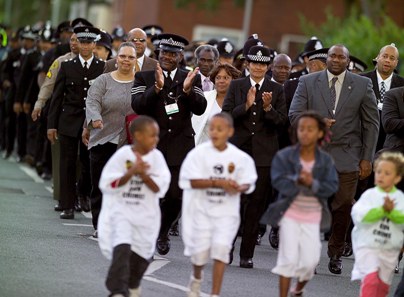
Nearly 7 years on from Macpherson we arrive at this time of the year again, our conference. I understand the concept of charging candidates to attend but am curious as to what other BPA's are doing in terms of charging for accomodation. Our BPA initially was to accomodate primary members at full cost, secondary members were to pay half accomodation costs and well, (yes half!), and who knows what the rights of tertiary members are?
Now, it would appear, after a revisit, our BPA may have seen that these priviliges/funding, etc. was not for the selected few BPA MEMBERS but for all members. When the concept of the BPA was set up we applied for funding to secure our attendance at conferences such as these with a little more liberty, freedom, and sanctity, knowing full well that we may have to sacrifice our personal freedom anyway. We applied for funding to secure our rights, freedom of speech, freedom of expression, etc. but what is the point if some cannot attend, but perhaps that is the point!
Then we did not have budgets and we paid from our own pockets. In 2005, we are said to have progressed to such a civilised status that now we have to work past the honour guard of Black people in order to challenge the ludicrous decisions of some BPA's and the organisation that sits their smugly saying, "It's a BPA decision!" Now, some of us have again to pay for our own freedom.
I can understand the BPA's taking from the organisation what is righfully theirs, but what would be consequentially acceptable and respectful is if BPA's ceased to take from those that are already disaffected amongst it's membership. Have we forgotten our purpose? But then BPA's are only doing what the "Master" organisation has taught them is what some may say. And so really is this civilised progress 7 years after Macpherson? Or is this yet another backlash to Macpherson? We still have some way to go........
Being Black in Blue
I see Bigots and Racists and Bullies and Creeps,
Of all ranks and all colours; all they think about is just “Me”,
As in “them,” is their true and complete ideology.
Some have made it through the ranks, from Sergeants and above.
They have given evidence at tribunals against anti racists, And stuff.
They still sail through as if they are so supreme,
What a fallacy, what a fascist regime?
They are Bigots believe you, believe me.
But they are totally totally free,To practice this evil, this malice, this disgust, Of Racism, of Attitude, Of Disrespect, Hatred and Grudge.
Towards innocent Black men,
That You and I truly trust.
And all this is based on colour,
Yes, all this is based on being “Black”,
on being portrayed as a “loose cannon”,
And on “their” perception of us being slack.
The thing is, They are the one’s that are freaky, Not me.
Nor are they my true friends, You see.
The Senior Managers know this is all true, But they too remain smitten,By English words of comfort.
“You fools”, you will crumble one day, I mumble.
The managers are hidden in their own glory and “self esteem”, like glue. Their passion is personal;
it’s about their career “kafumble”,
And their next post,
It’s about personal privilege, and promotion,
not “Me.”
No fairness, no freedom, no solace, no home.
This Corruption and Evil is of the highest discord,
It is Academic; its Futile, But who am I too moan.
I am Black and Proud, with Dignity,
Whilst some like me are Liars, you see.
All are superior by colour, by rank, and by birth.
All are superior by colour, by rank, and by birth.
And although I am educationally qualified,
To their bitter discontent, I can read,
I can speak, and most of all, whilst I write,
I remain unambiguously “Free”.
The jealousy is real, it’s against me,
The jealousy is real, it’s against me,
and it’s against being intelligent and Black.
As for ACPO, they are futile as leaders today,
As for ACPO, they are futile as leaders today,
They have neither a concept nor a clue,
Of “race”, of “riots”, of “fear”, of “terrorism” of “honesty”,
Of what it is really like being Black and in Blue.
This poem is dedicated to the memory of Stephen Lawrence, Oct 2005
Of what it is really like being Black and in Blue.
This poem is dedicated to the memory of Stephen Lawrence, Oct 2005
Celebration time - come on
Look at St George's day and you might find a contribution. I very much welcome the views of the new Archbishop of York. It is fundamental that in a multicultural and now integrated society people of all cultures accept, value and celibrate the existence of other cultures.
I feel that St Patrick's Day is another wonderful celebration. Isn't it great to see so many happy people? I also feel that if we celebrated more together there would be very little to fight or argue about in the name of religion, colour or culture. And perhaps there would be less in terms of racially motivated attacks also. It is therefore equally important that Black and Asian people take part in the celebrations of St George's Day. The celebrations could be a national holiday!
Once again, congratulations to the new Archbishop and let us look forward to some celebrations.
THE NBPA - cannot itself repent for the actions of it's own members

This has been lifted from the National Black Police Association website.
'We will have to repent in this generation not merely for the hateful words and actions of the bad people but for the appalling silence of the good people. 'Martin Luther King Jr.'
What about those in the NBPA who are keeping quiet to protect their privileges?
Policing - No will to change
This is absolutely wonderful what I read here in the Times. As a serving police officer that has dedicated most of my service to tackling racism's, institutional and personal, and against some Black and some White leaders, I am over joyed at the appointment of Dr Sentamu. From his days which resulted in the Stephen Lawrence Enquiry Report and his involvement in the Damilola Taylor murder, I know and feel that the only way things will change is when we are forced to change and that is not only in the police service, but in mainstream society. Whilst on the surface in the police service their appears a "will" to change, below that surface some of the service's most aspirational leaders are deliberately not coming to terms with what is actually required to fruition the reccomendations made by Macpherson and Cantle. This will not be good enough now for Dr Sentamu.A policy here, a policy there means little if there is no will. Quite recently the Home Office prematurely ended the Stephen Lawrence steering group and just last week we were reminded that Anthony Walker was murdered because of the colour of his skin. If I talk a little about my faith, Hinduism, I am convinced that some Hindus remain oblivious to what is happening. It is almost as if people do not want to own things. As peoples we have to let go of our cultures to a certain extent and now unite and reform faiths.The reality of terrorism, the reality of race hate crime and the demise of multiculturalism will lead us to a new level of integration and I pray that it is Dr Sentamu that leads us through this change.What makes me smile most is that Dr Sentamu has scared the daylights of those that do not wish to change, and he has the leaders of the police service, and the Home office at his feet. This is good. We have to move away from forums and beaurocracy and tokenism and a yes sir, no sir, three bags full sir, approach that currently exists and results in a tick in the box or targets.The change and values I feel he wants to instill in modern day Britain are things only he can achieve with love and compassion, but if organisations and people refuse to listen, I tell you what, Dr Sentamu will continue to beat those drums and I will be able to hear them from York, not Africa, but from York!And this strength will allow me to continue in what I need to do too. I am now left pondering is Dr Sentamu a Hindu or am I a Christian. This is truly God's work. By the way, as a firm England supporter, I note that David Beckham, the England captain, has a cross tattoed on the back of his neck. This only means that we are taking God with us to the World Cup in 2006! Britain and England has so much to offer that we are now in very exciting times. And what is best of all, is that whilst some Black colleagues inside the service view me as a bit of an outspoken "loose cannon" and stifle what I am trying to say, Dr Sentamu has made me feel free! Sir Trevor Phillips sounded off a serious warning sign that parts of the country were sleepwalking into ghettoism. But people simply are scared to talk about segregation or multiculturalism as issues that are here today in modern Britain. As people we can only live together if everyone shares the same views so to speak about life. In essence are our faiths different routes to the same place. Some faith leaders still argue that they are not. We all must accept that no faith is superior to the other; but today we are simply not at this position. Differences seem to cause racism and the fanaticism that we see in the extreme right wing is the same as the fanaticism of terrorism, but then racism in a milder form is no different to terrorism. There are also fine lines between integration and human rights and practising one's own beliefs. Breaking down racial and religious barriers will require integration from us all and perhaps there will be a new level of multiculturalism. But all faiths must be ready to reform for what it is to be British, for in this we have a common identity. Whilst the CRE can lead councils, the police, afaiths to water, it is unable to make councillors, police and faith leaders drink that water. Some still feel the CRE has an agenda, and perhaps it has; I thought the agenda of Trevor Phillips was anti-racism. I hope now that the new Archbishop can add his weight to the debate of identity, race and religion.
The Archbishop himself sent this to me
Thank you so much for your email and for the copy of your contribution to The Times website. I am sorry to have taken so long to reply, but I have been deluged with correspondence. Your work on the follow-up to the Stephen Lawrence Enquiry Report is of crucial importance. I trust it has helped to instigate a real change of attitude in the Police Force and beyond, though more effort is needed and we must all continue to be vigilant. Please, never lose heart.You as a Hindu and I as a Christian have much that we can do in harmony together and for the common good. There will of course be occasions when we shall speak from our personal and separate convictions: when that happens I pray that we shall be open-hearted and open-minded so that we may grow in all that is true and good.
It is absurd to suggest Black African Caribbean people have failed and Asians have prospered becau- if we believe in this we have failed race equality

The experience of being Black is respective to the social and political conditions and climates of one's home. It is dependent on how one is made to feel. And some homes are better than others as our writer from America advises us. There is absolutely nothing wrong in that. It is a fact.
Am I witnessing "migrant versus migrant" here, I ask? There is a suggestion that Black African people can do better or that Asian people have thrived whereas Black African people have historically not, even in their homeland. But even in the homeland the systems perhaps are Colonial.
I come back to the experience of being Black and facing racism or corruption. It is entirely dependant on power and the social and political norms of a country at any given time. I am not so sure that Black and Asian peoples can be compared in this way. We are all different, none is better, since we may have some different values we have different life experiences. T
his does not mean one group has failed and the other prospered. But we have all and we still do continue to suffer different forms of racisms.
Marginalised kids will end up in prison
Institutions and individuals have no concept that their actions, attitudes and behaviour might have come from a basis of a perceived superiority that they have inherited. The worst result of this continued marginalisation is murder, e.g. Menson, Lawrence, Walker.
Supremacists simply do not wish to apologise. We could honour the plight of Black people in Slavery. How we do that I do not now, but someone suggested some monuments.
This and some fresh funding for marginalised minority ethnic people might go some way in tackling the current issues of cohesion and integration. How we keep Black and Asian kids off the streets and from offending is key. Otherwise, all we will do is simply imprison an already marginalised Black youth.
Breaking barriers and getting Asian kids into professional football and rugby is another way forwards I guess.
Don't blame White senior managers alone - blame those Black colleagues that "effect" in the pocket of these people also.
Sadly even today I have seen this same "migrant versus migrant" approach inside the National and local Black Police Associations up and down the country. Some of the Black people/officers that we entrust with power simply do not have an effective understanding of race but are kept in power.
The institution can then say it has consulted with the NBPA, but this is "false" consultation. Find me one Black officer since Dr Dilzaie, that has challenged race issues vociferously, and I would suggest most just simply bury their heads in their lives in order to survive.
I have even heard a senior member say in front of the Chief Constable that they are economical with the truth because they fear losing the privileges given them. And what did the Chief Constable do with this information? Sadly nothing.
And so inside policing and in wider society we have the development of a false race relations industry and this is because those in power simply do not wish to hear the experience of Black marginalised voices and this is where we are at. Even inside policing this "migrant versus migrant" approach exists and the institution simply allows it to continue for as long as it continues the real problems of race relations remain unchallenged and the balance of power remains predominantly racist, all be it "unwittingly."
Don't write to the Met Commissioner - His "bag carriers" are good at protecting their boss but useless at dealing with the truth
We are reminded again of the race riots of the 1980's, and ever since, year in, year out, the police service as a whole has said it is doing all it can in order to deal with "race". This is perhaps a half truth. The hierarchy of the police service is mainly white and the majority at the top simply do what they can according to their own understanding. The senior-middle level is promoted by those at the top, and are also mostly white, and merely mimick what those at the top wish to hear. No one at the top wants to understand the difficult reality of dealing with poor "race" relations. This unfortunately is the reality of the police. But this is not the whole picture. Most of those that are black and have got to the top have not themselves challenged racism vociferously. Those that do genuinely challenge racism are left on the periphary and this leaves those black officers that are deemed trustworthy to consult with chief officers, but these people simply do not wish to prejudice their careers. Challenging "race" in the police service is a career decision; ask any officer that has challenged. And if you ask these officers what learning has come out of the incidents then the answer will probably be, none. The current systems that exist in the police service do not inspire openness and transparency from our leaders. I wrote to the Met Commissioner about the Jean Charles de Menezes incident; and this was before the IPCC had reported. I raised my genuine concerns that Mr de Menezes may have been racially stereotyped. I received no response to my e-mail. I e-mailed again and received a patronising response form the "guard" or Staff officer. In my frustration at the lack of foresight of the Met to acknowledge the existence of racial stereotypes in this incident, I wrote again. I was advised that my emails would be sent to my Chief Constable. I then met with my Deputy Chief Constable and was advised that although my intentions were pure I had offended the Metropolitan police and that I should back off because they had advisors. Banging one's head against this brick wall is a continuing challenge for some of us because they had missed the point; Jean Charles de Menezes was the subject of racial profiling and if the advisors had any integrity or passion for "race" the Met would have admitted this. I also advised that each of the 7/7 killings should be recorded as a religiously aggravated murder. I got no thanks or acknowledgment for my foresight or understanding here. If the way police services promote is changed then instantly we will have an impact on "race." Also if we sack those that practice malicious racism, particularly those at the top that condone it; then I am certain we will see change overnight.
Subscribe to:
Posts (Atom)